
Bitterness and Hopes of an Ordinary Life
A review of the short film Lay Lefty Down, directed by Traven Rice

It is almost impossible to overstate the importance of an opening shot. The first image, the first scene, and the first sequence in a film carry enormous weight, because it is through this initial encounter that the viewer becomes acquainted with the world of the work. If that acquaintance is not established in a satisfactory way—if the spark fails to catch—the audience may lose focus and interest, and reclaiming their attention afterward will take considerably more time. In a short film, however, this matter becomes nearly vital. There is simply no second chance to recover a viewer’s lost concentration. If the filmmaker fails to hook the audience with that very first image and direct their gaze toward the work, the odds are high that they will never regain it. The opening shot, and the shots that shape the first sequence, remain the best tools any short-film director has for fully capturing the viewer’s attention, inviting them into the film’s world, introducing them to the story’s universe, and only then—once interest has been secured—telling the tale. In the short film Lay Lefty Down, Traven Rice succeeds admirably in constructing an exemplary sequence of precisely this kind.

The film opens on Abby sitting behind the wheel of a car, taking a drag from her e-cigarette. From the headband and her sparse eyebrows we can already guess that she is ill, though the film places little emphasis on the fact. In this first step the filmmaker has introduced the character while situating her in a contradictory and ambiguous position. The viewer begins to wonder: this person who appears to be sick—is she really? If so, the act of smoking only deepens the ambiguity. Who is she, and where is she going? She does not seem to be in particularly good spirits—tired, or perhaps sad. Yet the shot does not linger. The filmmaker quickly establishes the setting. The woman steps out of the car and walks toward the house; when she opens the door she is met by a gathering of people ready to surprise her. The information arrives in such rapid succession that there is no opportunity for the viewer’s interest to slip away. We assume it must be her birthday. Then Aunt Eudora shatters that assumption. This is a Boob Funeral—a funeral for Abby’s left breast! Friends and acquaintances have gathered with hats, balloons, drinks, cake, and all the necessary party paraphernalia to bid farewell to the left breast. It is a funny premise that both balances the heaviness of the opening shot and draws the viewer toward what follows.

Many works set in a confined environment generally require a strong conceptual foundation to compensate for the absence of other elements. When a filmmaker restricts themselves to the interior of a single location—a house, a courtroom—they can no longer rely on the appeal and variety of changing images. They cannot satisfy part of the viewer’s visual appetite by moving between different locations. Something must therefore take the place of that variety. Ideas must be used whose inherent attractiveness can carry the audience’s mind along with them. Traven Rice does exactly that. One of these ideas, beyond the simultaneously comic and bitter premise of the Boob Funeral itself, is character development that emerges from situations that are at once humorous and serious—situations performed in a witty, comic register yet carrying a sharp, serious, and painful content. Situations that place people inside a colorful, cheerful world while, beneath the surface, pointing to their loneliness and wounds. The deliberate use of these contradiction-centered situations is the greatest strength of Rice’s work.

Among these situations is the scene in which Abby confronts her ex-husband. In just a few words, through the exchange of one or two lines of dialogue, we understand that after Abby’s cancer diagnosis her husband left her. Rice’s extraordinary strength lies in knowing how to convey, with the lightest of touches—a few words, a brief exchange—everything we need to know about the characters’ past. Viewers from widely different backgrounds can easily connect with these people and their circumstances because the material is rendered in the fluent language of cinema and performance. The actors’ work is natural yet rich in carefully observed detail, and the rhythm of their performances is so well matched to the story’s progress that no distance opens between the audience and the film.
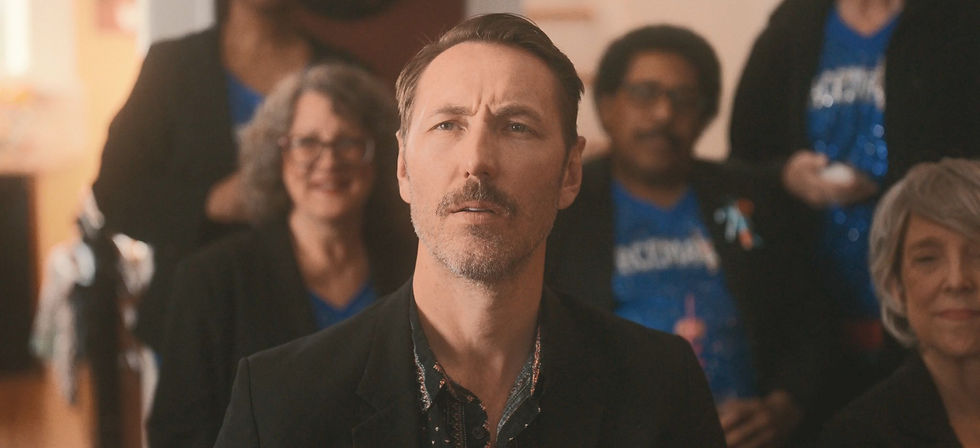
From these situations, and with the help of controlled, thoughtful performances, the film builds characters who feel believable and tangible. It reveals their past to the degree the story requires while simultaneously advancing the present-day narrative. The filmmaker does not dwell solely on past events; the intention is also to move forward the story of the present moment—the Boob Funeral party itself. Advancing these two narrative threads at the same time is another hallmark of the well-written screenplay of Lay Lefty Down. The film makes no grandiose claims and does not begin with heavy, abstract concepts that it later fails to develop. Instead it simply tells the story of a person in a difficult situation—facing cancer—and places her at a point where she is forced to confront her bitterness, including her ex-husband.

The film’s most brilliant quality is the way it transforms that initial comic premise—the Boob Funeral—into a source of moments that are simultaneously wild and deeply human. When different people speak about their memories of Abby’s breast, we realize how human and compelling the film’s central idea truly is. When Abby’s former roommate begins her recollection of the left breast (starting, in fact, with “Everyone wanted to get into Abby’s pants”), we feel that these words, this funeral ceremony, function as a kind of gratitude—gratitude from people who love Abby and want to show her that she matters to them, and that although she is trapped in a hard situation she still has friends who care. While the director looks at the world with a realist eye and presents divorce and cancer as undeniable realities, these scenes demonstrate that he is also a humanist—that his realism is not merely bitter. This balanced perspective extends to every detail of the film; even the other dimensions of Aunt Eudora’s character, who at first might seem merely cheerfully superficial, are later revealed to the viewer in a deep and human scene.

Lay Lefty Down is a film that is watchable, delicate, and artful, focusing on human relationships, everyday tragedies, and the hopes of ordinary life. It is beautifully directed in a way that the director’s presence is never felt, and it tells its story in a fluent, unforced language.



Comments